
EMDR procedure vs. OEI Therapy
When you talk about trauma in detail, you’re not just remembering it—you’re reactivating it in the brain.
This process is called revivification.
Your brain lights up as if it’s happening now.
The same neural pathways that formed during the trauma fire again, reinforcing the memory and the painful emotional responses that comes with it.
From a neuroscience perspective, every time you talk about a traumatic memory, the brain has a window where the memory can be changed—but if nothing shifts, it can actually strengthen the distress signal.
How EMDR works for trauma
Eye Movement Desensitization and Reprocessing (EMDR) uses bilateral stimulation—usually guided eye movements—to help the brain process trauma in a way that reduces its emotional intensity.
But first you have to recall your trauma.
EMDR is one of the most well-researched trauma therapies and has helped many individuals reduce PTSD symptoms. But it does have challenges:
- Some find it overwhelming to bring up painful personal memories
- It can be difficult to tolerate if the trauma is complex or overwhelming
- The process can feel too intense for someone who is traumatized
- Some drop out before benefits take hold because the procedure feels too activating
Why OEI therapy can be safer and gentler
Observed and Experiential Integration | OEI Therapy has evolved from EMDR. Taking the benefits of bilateral stimulation but uses targeted visual techniques that will not require you to verbalize or re-live the trauma.
Based on neuroscience, OEI works with the brain’s visual processing and attention systems to help shift trauma responses without flooding your brain and body with painful memmories.
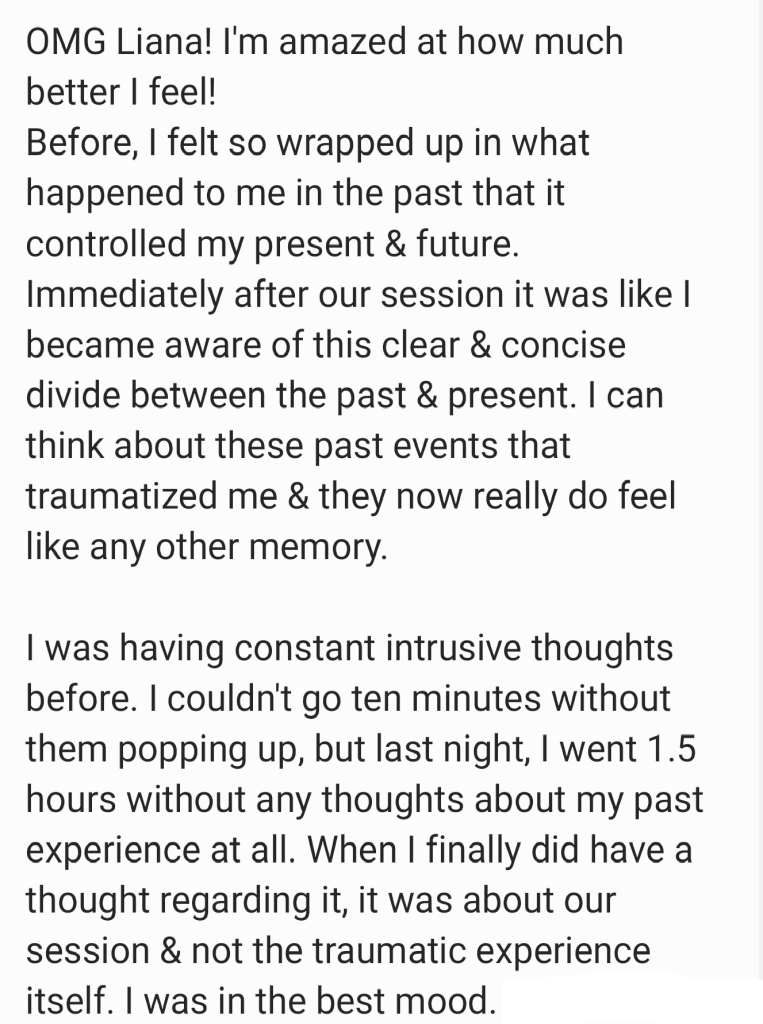
OEI can be especially helpful for those who can’t tolerate traditional EMDR because it keeps activation low while still allowing the brain to rewire. This gentler approach prevents re-traumatization while still promoting neuroplastic changes that integrate the trauma into the past.
Let’s connect.
Listen, are you breathing just a little and calling it a life?
-MO


























 Accelerated OEI Therapy
Leave a comment