
How OEI Therapy Helps Integrate & Heal Trauma
When something traumatic happens, your brain gets overwhelmed. Instead of processing the experience like other memories, it fragments the memory. That’s why trauma memories often feel incomplete. You don’t get a complete narrative of the experience because it is just too overwhelming for your brain. So it’s not to file it away like other memories, this is why you’re not in control of the recall of the experience, the memories run you.
They pop up into your awareness in fragments of intrusive thought and feelings that capture the intensity of the experience—a smell, a flash of a face, a sudden wave of panic—fragment of trauma.
The brain doesn’t store traumatic memories in a neat, verbal narrative. The thinking part of the brain (the cortex) goes offline, and the emotional and survival parts (the midbrain) take over. Your body reacts, and you’re not able to access the responsive, regulated, resilient parts of your brain.
Why Traditional Therapy Often Falls Short
Traditional talk therapy tries to make sense of things using logic and understanding. We think that if we can understand it, we can fix trauma. So we painfully, try to talk it through, remember it and piece things together logically.
But here’s the thing.
Logic Can’t Fix Emotion.
Remembering is not Recovering.
The intensity of the overwhelm can get worse as you try to talk about it, causing an iatrogenic effect, where talking about it, unintentionally retraumatizes you. So you keep going back to therapy because it’s worked with other problems.
Trauma is Different
Trauma isn’t filed away in the past like other memories, it is fragmented and stays in the present tense. It isn’t stored in language, it’s stored in non-verbally, in your body, what you saw, how you felt.
This why many you feel triggered AF after talking about trauma, it revivifies it and makes you experience it again with the most intense feelings of the experience.. You keep repeating your story to anyone who will listen because you think it will help fix the trauma, but nothing changes. The emotions stay raw. The body stays on edge. The memory still feels like it’s happening now.
How OEI Therapy Works Differently
OEI (Observed & Experiential Integration) helps the brain do what it couldn’t do during the trauma: process and integrate the memory.
Here’s how the brain integrates the memory:
Left + Right Brain
Trauma often gets stuck in the right brain—fragments of intense emotions, impressions, and body sensations in the subconscious. OEI acts like a bridge, linking these random, raw non-verbal experiences with the left brain—conscious, logical abilities to analyze and organize. Integration can help turn jumbled, threatening memories into something you can understand and process into the past, making them feel less overwhelming as they get filed away into memory.
Front + Back of the Brain
OEI therapy connects the front of your brain (prefrontal cortex), the verbal part of your brain that perform reason and regulation with the back of your brain (occipital lobe) that is visual, and holds vivid memories of trauma and disturbing images that flash into your consciousness, keeping you stuck in feelings of vague threat.
OEI helps connect the verbal part of the brain with the visual part where the brain tries to make sense of what they have seen in traumatic experiences.
Midbrain with Outer Layers
OEI helps connect the midbrain that is involved in fight or flight reactivity with the prefrontal cortex, the thinking, regulating, responsive, and resilient part of the brain. OEI therapy integrates these parts of the brain to create creates a felt sense of safety, emotional regulation and resilience as the PFC helps to regulated the brain so the hippocampus can file the memory away into the past.
What Integration Feels Like
With OEI, you don’t have to talk through painful, personal details of your experience, besides, you might not even remember or are trying super hard to forget.
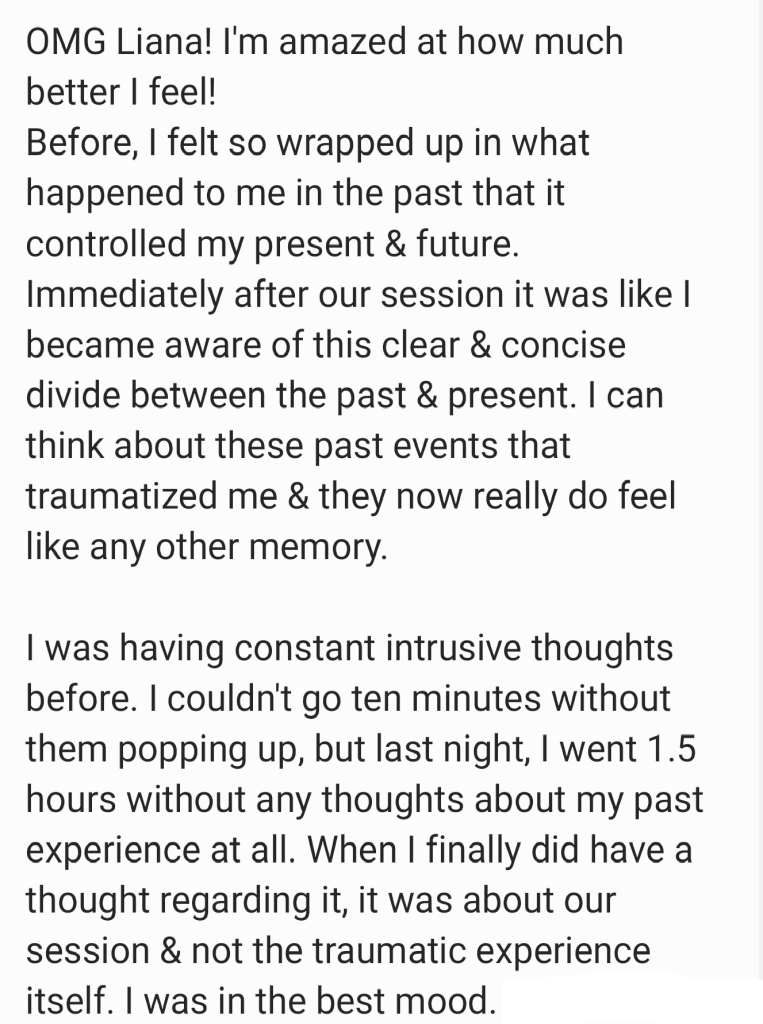
OEI therapy helps trauma lose its edge by integrating it. And when trauma is integrated, it feels like it is in the past tense, not being re-lived in the present moment. You will start to notice shifts in the way it feels that is further away in the past with each passing day.
Clients begin to rediscover hope as the trauma moves out of their “here and now” into the past. The re-discover themselves, living without trauma and start to feel hopeful about moving forward into a whole new future.
That’s how integration works—it’s subtle but powerful. You feel a sense of distance from the memory as it moves into the past, where it belongs.
Why This Matters
You can’t heal what your brain can’t process, no matter how much you talk about it, the underlying emotions will still be there.
OEI allows your brain to do what it needs to complete the process and put the experience into the past, out of your future. Instead of intrusivie thoughts and intense feelings that keep you looping throught painful memories, you start to feel calm, clear, and present.
You don’t have to relive it to release it.
Listen, are you breathing just a little and calling it a life?
-MO



























 Accelerated OEI Therapy
Leave a reply to Why Is OEI Therapy Called Observed & Experiential Integration? – Accelerated OEI Therapy Cancel reply